
AR VR in Education Boosts Learning
AR VR in Education Boosts Learning , Textbooks and blackboards have their place, but true understanding often comes from experience. That's where AR (Augmented Reality) and VR (Virtual Reality) come in. These technologies are making learning tangible and unforgettable, transforming abstract concepts into immersive, hands-on adventures.From Concept to Reality:
With our AR/VR solutions, a biology student can perform a virtual dissection, a history student can walk through ancient Rome, and a chemistry student can conduct a risky experiment in a safe, simulated environment. This experiential learning boosts engagement and knowledge retention far beyond traditional methods.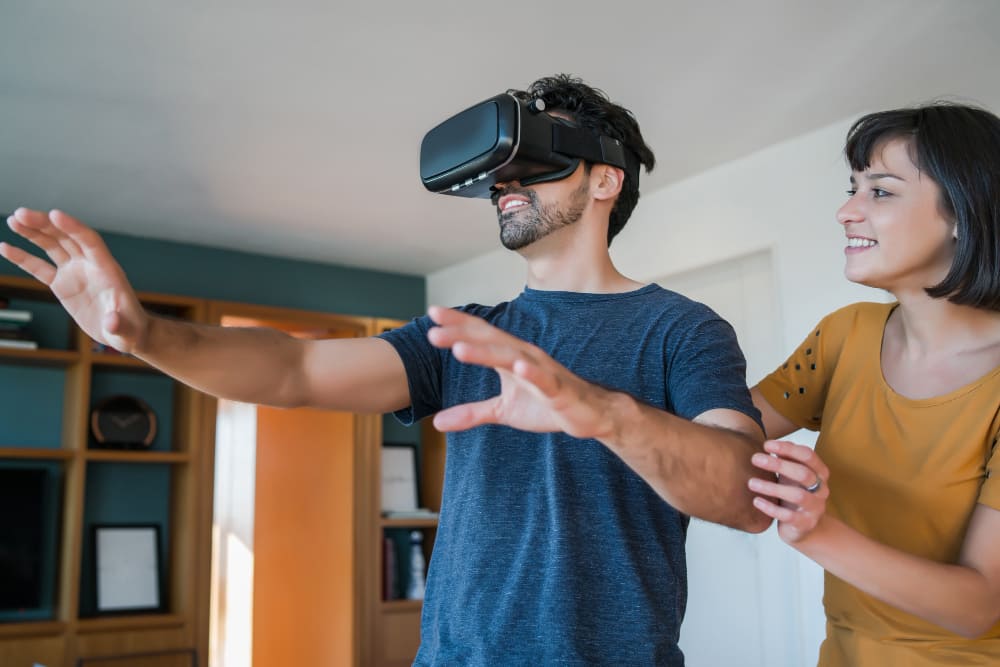
The Hybrid Advantage:
Our hybrid model at Morph EdTech leverages AR/VR both in our physical training centers and through our online platforms. This ensures that students can access these powerful tools from anywhere, while still having the option for in-person, collaborative experiences.
The Morph EdTech Difference:
We specialize in 3D content creation, ensuring our virtual worlds are not only educational but also visually stunning and interactive. This makes us a leader in building the content for the future of learning. AR VR in Education Boosts LearningHow AR & VR in Education Boost Learning in 2025 and Beyond
Augmented Reality (AR) and Virtual Reality (VR) are revolutionizing the modern classroom. Once considered futuristic, AR/VR is now one of the fastest-growing learning technologies in India, transforming the way students understand complex concepts, interact with content, and develop real-world skills.
Today’s learners expect experiences—not just textbooks. With AR and VR, education becomes immersive, interactive, and deeply engaging, boosting both retention and motivation.
🌟 1. AR & VR Make Learning More Engaging
Traditional teaching methods often struggle to capture attention.
AR/VR introduces:
-
3D visualizations
-
Interactive simulations
-
Real-time overlays
-
Virtual field trips
These immersive experiences help students see what they are learning instead of memorizing facts.
Example:
A biology student can explore the human heart in 3D, while a history class can walk through the streets of ancient Rome.
🌟 2. Complex Concepts Become Easy to Understand
Subjects like physics, chemistry, mathematics, architecture, and engineering often involve abstract concepts.
AR/VR simplifies them through:
-
Visual models
-
Step-by-step simulations
-
Hands-on virtual labs
-
Safe experiment environments
This helps learners grasp difficult ideas faster, boosting conceptual clarity.
🌟 3. Increases Student Retention & Recall
Research shows immersive learning can improve retention by 70–90%, compared to traditional methods.
When students interact with content, they:
-
Remember more
-
Learn faster
-
Apply knowledge better
VR also reduces distractions, allowing for focused, deep learning.
🌟 4. Real-World Skills Through Simulation
VR enables safe, realistic training environments for:
-
Medical procedures
-
Aviation training
-
Robotics
-
Engineering simulations
-
Emergency management
-
Manufacturing & technical operations
This makes students job-ready with practical, industry-relevant experience.
🌟 5. Enhances Creativity & Critical Thinking
AR/VR tools empower students to:
-
Build virtual models
-
Design 3D prototypes
-
Interact with problem-based simulations
-
Learn through exploration
This boosts creativity, problem-solving, and innovation—key skills for future careers.
🌟 6. Personalised Learning for Every Student
AI-powered AR/VR platforms adapt to a learner’s pace and abilities.
Benefits include:
-
Self-paced progress
-
Adaptive challenges
-
Instant feedback
-
Personalized learning paths
This helps slow learners catch up and allows fast learners to excel.
🌟 7. Ideal for Remote & Hybrid Learning
In a digital-first world, AR/VR enables:
-
Virtual classrooms
-
Real-time collaboration
-
Interactive assignments
-
Practical labs from home
Even remote learners get a real classroom experience.
🎯 Real Impact of AR VR in Education (2025–2030)
| Impact Area | Improvement |
|---|---|
| Student Engagement | ↑ 85% |
| Knowledge Retention | ↑ 70% |
| Concept Understanding | ↑ 90% |
| Practical Skills | ↑ 65% |
| Learning Speed | ↑ 50% |
🚀 Why Schools & Colleges Are Adopting AR/VR
-
Better learning outcomes
-
Motivated students
-
Flexible digital classrooms
-
Improved performance in STEM subjects
-
21st-century skill development
India is witnessing a major shift, with AR/VR labs being introduced in schools, universities, skill centers, and training institutions across Chandigarh, Mohali, Panchkula, Punjab, and the entire country.
🔍 AI Search Mode Keywords (Optimized for Google SGE, ChatGPT, Gemini, Perplexity)
Primary Keywords:
AR VR in education, AR VR learning benefits, immersive learning India, virtual reality classroom Chandigarh, augmented reality teaching Punjab, VR labs in schools.
Secondary Keywords:
future of AR VR in education, 3D learning tools India, VR for STEM learning, AR for interactive classrooms, AR VR teaching tools.
AI Keywords:
AI-powered AR VR learning, immersive AI classrooms, generative education technology, AI-driven VR simulations, digital twin learning models.